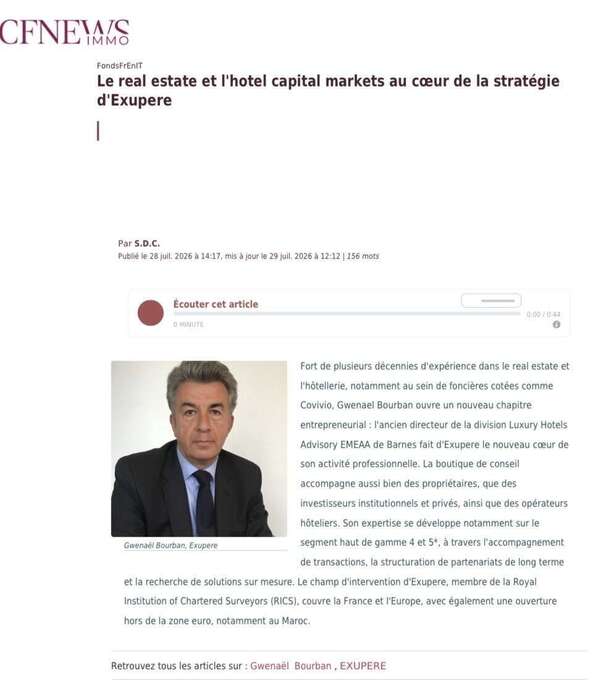
Q&A Interview: English and French | Seven Years — The Year of Freedom.
This year, on April 12, 2026, Exupere is celebrating its seventh anniversary—and seven years is no small feat in an industry that, over the course of a single decade, has had to contend with a global pandemic, armed conflicts in Europe and the Middle East, and climate disruptions whose impact on tourist flows and investment strategies continues to worsen.
❓ How would you describe your career path in terms of investments rather than in professional terms?
Answer:
I have never really thought in terms of a traditional career path, but rather in terms of gaining exposure to different investment environments. I worked at institutions where real estate was treated as a strategic asset class, with clear allocation frameworks, risk management processes, and long-term value creation objectives. That shaped the way I think more than any specific role.
I have also always had a consistent interest in the hotel investment sector, dating back to the 1990s and continuing to this day, even though I spent extended periods working on other asset classes. This includes the London office market, as well as industrial and logistics platforms, which keep you grounded in the fundamentals of real-economy assets.
For me, hotel investment has always been a B2B business at its core, but with a unique blend of business and leisure elements that naturally gives it a more international and experiential dimension.
⸻
❓ What did institutional environments teach you about capital?
Answer:
Discipline, above all. Investment decisions are rarely driven by emotion in such environments. They are the result of structured processes, multiple perspectives, and a continuous assessment of risk versus return. You also develop a strong understanding of economic cycles—and of the importance of timing in capital allocation.
⸻
❓ Do you still consider yourself an investor today?
Answer:
Yes, in terms of mindset. Even though my role has changed, I still approach situations from an investor’s perspective. I consider risk, return, and how value is created over time, rather than focusing solely on the transaction itself.
But of course, my investor’s mindset never really switched off. I believe in the advice I give. Skin in the game, as they say—selectively, and on the right terms.
⸻
❓ When did you transition from institutional investing to advisory work?
Answer:
It wasn't an abrupt change. It was a gradual evolution. Over time, I became more involved in connecting investors, operators, and assets, and in structuring transactions rather than simply analyzing them. At some point, my role naturally shifted toward advisory services and deal structuring.
⸻
❓ What sets your current role apart from traditional brokerage?
Answer:
Matching parties is not an end in itself. I focus on structuring investment partnerships and ensuring that different stakeholders—investors, operators, and asset owners—are aligned. Each party has different constraints and time horizons, and the value lies in bringing those together into a workable structure.
⸻
❓ Where is value actually created in today’s hotel investment market?
Answer:
Increasingly, value lies not merely in access to assets, but in how they are structured. The hotel sector is unique because it combines real estate and operations. Value creation depends as much on the operator and the business plan as it does on the asset itself.
⸻
❓ Are the most attractive assets still available on the market?
Answer:
Not necessarily. A significant portion of transactions still takes place off-market, often for reasons of confidentiality or strategic positioning. But visibility is no longer the key issue. The real question is how you structure the transaction once an opportunity is identified.
⸻
❓ Is there such a thing as the right investor for a hotel property?
Answer:
Absolutely—and this is perhaps the most underestimated aspect of hotel investment. A rare asset doesn’t simply need capital; it needs the right capital. The right investor understands that a unique hotel—whether a historic palace, a converted estate, or an urban landmark—has a value that goes beyond mere returns. It has an identity, a positioning, and sometimes a legacy. Matching that asset with an investor who respects that uniqueness, and who brings in an operator aligned with the same vision, is what defines a well-structured transaction. Rarity, in this market, is not only about scarcity of supply. It is about the alignment between asset, operator, and investor—which is itself rare.
———
❓ How do you see the investor base evolving in the hospitality industry?
Answer:
It has become much more diverse. Institutional investors remain active, but family offices and private investors now play a much larger role. They tend to be more flexible, especially in the high-end and luxury segments.
⸻
❓ Is the market becoming more financial or more operational?
Answer:
It is becoming more hybrid. Financial discipline is stronger than before, but hotel assets remain fundamentally operational. You cannot separate the real estate from the business performance.
⸻
❓ You operate mainly from France. Why?
Answer:
France is my home base, but I see it as an international platform. It is where I connect with investors and initiate deals that span Europe and, in some cases, extend beyond the eurozone. The key is not geography, but capital flows and investor reach.
In addition, France has a highly regulated legal framework for real estate and hotel transactions. This regulatory framework establishes a clear distinction between structured advisory work and informal intermediation. It is something I bring to my international engagements—not as a constraint, but as a mark of credibility that reassures counterparties, even in jurisdictions where equivalent requirements do not formally exist
⸻
❓ Does location still matter in hotel investment?
Answer:
Geography still matters—perhaps more than capital flows suggest. Investors have adopted a global perspective in their allocation strategies, and barriers to cross-border investment have largely disappeared. But a hotel is not a bond. It is embedded in a local market, a micro-location, and a cultural context. The investors who perform best in this sector are those who understand that global capital must be combined with local insight. Proximity to the asset—or to those who truly understand it—remains a genuine advantage.
⸻
❓ What role do institutional standards play in your current work?
Answer:
They remain essential. They bring rigor, analytical discipline, and a structured approach to decision-making. But they must always be adapted to the operational reality of hotel properties, which is far more complex and less standardized.
And this remains entirely true whether you are working with an Anglo-Saxon international fund, a family office, or a private investor in France or elsewhere.
⸻
❓ How would you describe your role in one sentence?
Answer:
I would say my role is to facilitate investment partnerships between capital providers, operators, and asset owners in complex hotel transactions.
By “complex,” I mean that things can sometimes be very complicated when you’re involved in projects such as hotel development, club deals, and other partnerships between co-investors and operators, or public-private partnerships, and have to deal with various administrative bodies such as city hall, the prefecture’s urban planning department, architects, and so on…
It’s both fascinating and… utterly gripping!
Have I exceeded the one-sentence limit?
⸻
❓ What is the main challenge in these transactions?
Answer:
Alignment. Each party—investor, operator, owner—has different objectives, timelines, and constraints. The challenge is to create a structure in which these differences are compatible rather than conflicting.
❓ How do you see the hotel investment market evolving?
Answer:
It is becoming more sophisticated, more institutional, and more operational all at once. This combination makes transactions more complex, but also creates opportunities for more structured forms of capital deployment.
⸻
Closing remarks
In an increasingly hybrid market—spanning real estate and operations, institutional capital and private investors, local assets and global capital flows—the role of intermediaries is evolving. It is no longer simply a matter of connecting parties, but of structuring transactions where different investment approaches can come together.
#Exupere #ExuperePerspectives #HotelInvestment #LuxuryHospitality
--FRENCH VERSION--
This year, on April 12, 2026, Exupere celebrates its seventh anniversary—seven years is no small feat in an industry that, in the span of a single decade, has weathered a global pandemic, armed conflicts in Europe and the Middle East, as well as climate disruptions with growing consequences for tourism flows and investment strategies.
Q&A Interview
❓How would you describe your investment journey rather than your professional career?
Answer:
I’ve never really thought in terms of a traditional career path, but rather in terms of exposure to different investment environments. I’ve worked at institutions where real estate was treated as a strategic asset class, with clear allocation frameworks, risk management processes, and long-term value creation objectives. That’s what shaped my way of thinking more than any specific role. I’ve also always had a consistent underlying interest in the hotel investment sector, from the 1990s to the present day, even though I’ve spent long periods focused on other asset classes. This includes the London office markets, as well as industrial and logistics platforms, which ground you in the fundamentals of real-economy assets. For me, hotel investment remains, at its core, a B2B business—but with a distinctive blend of business and leisure dynamics that naturally gives it a more international and experiential dimension.
? What have institutional environments taught you about capital?
Answer:
Discipline, above all else. Investment decisions are rarely driven by emotion in these environments. They result from structured processes, cross-checking, and a continuous assessment of the risk-return profile. We also develop a deep understanding of market cycles—and the importance of timing in capital allocation.
? Do you still consider yourself an investor today?
Answer:
Yes, in my mindset. Even though my role has changed, I still approach situations from an investor’s perspective. I look at risk, return, and how value is created over time, rather than focusing solely on the transaction itself. But of course, my investor mindset has never really faded. I believe in what I advise. Skin in the game, as they say—selectively, and under the right conditions.
? How did you make the transition from institutional investing to consulting?
Answer:
It wasn’t a sudden shift. It was a gradual evolution. Over time, I became more involved in connecting investors, operators, and assets, and in structuring transactions rather than simply analyzing them. At some point, the role naturally evolved toward advisory services and transaction structuring.
? How does your current role differ from traditional transaction advisory services?
Answer:
Matching parties is not an end in itself. What matters is structuring investment partnerships and aligning the various stakeholders—investors, operators, and asset owners. Each party has different constraints and time horizons, and the value lies in the ability to bring these perspectives together into a viable structure.
? Where is value actually created in today’s hotel market?
Answer:
Increasingly, value lies not merely in access to assets, but in how they are structured. The hotel sector is unique because it combines real estate and operations. Value creation depends as much on the operator and the business plan as it does on the asset itself.
? Are the most attractive assets still available on the market?
Answer:
Not necessarily. A significant portion of transactions still takes place off-market, often for reasons of confidentiality or strategic positioning. But visibility is no longer the central issue. The real question is how to structure the transaction once the opportunity has been identified.
? Is there an ideal investor for a hotel asset?
Answer:
Absolutely—and this is perhaps the most underestimated aspect of hotel investment. A rare asset doesn’t just need capital. It needs the right capital. The right investor understands that a unique hotel—whether it’s a historic luxury hotel, a converted estate, or an urban landmark—operates according to a logic that transcends mere financial returns. It has an identity, a positioning, and sometimes a legacy. Matching this asset with an investor who respects its uniqueness and partners with an operator who shares the same vision—that is what defines a well-structured transaction. Rarity in this market is not solely about the scarcity of supply. It lies in the alignment between asset, operator, and investor—which is, in itself, rare.
? How do you see the investor base in the hotel industry evolving?
Answer:
It has become much more diverse. Institutional investors remain active, but family offices and private investors now play a much more significant role. They are generally more flexible, particularly in the upper-upscale and luxury segments.
Is the market becoming more financial or more operational?
Answer:
It is becoming more hybrid. Financial discipline is more pronounced than before, but hotel assets remain fundamentally operational. You cannot separate real estate from operational performance.
? You operate mainly from France. Why?
Answer:
France is my base, but I see it as an international platform. It is from here that I connect with investors and initiate transactions that extend across Europe and, in some cases, beyond the eurozone. What matters most is not geography, but capital flows and the reach of investors. Furthermore, France has a highly regulated legal framework for real estate and hotel transactions. This regulatory rigor establishes a clear boundary between structured advisory services and informal intermediation. This is something I bring to my international engagements—not as a constraint, but as a benchmark of credibility that reassures counterparties, even in jurisdictions where equivalent requirements do not formally exist.
? Does location still matter in hotel investment?
Answer:
Geography remains as important as ever—perhaps even more so than capital flows might suggest. Investors have adopted global allocation strategies, and barriers to cross-border investment have largely disappeared. But a hotel is not a bond. It is rooted in a local market, a specific location, and a cultural context. The investors who perform best in this sector are those who understand that global capital must meet local insight. Proximity to the asset—or to those who truly understand it—remains a real competitive advantage.
? What role do institutional standards play in your current work?
Answer:
They remain essential. They bring rigor, analytical discipline, and a structured approach to decision-making. But they must always be adapted to the operational reality of hotel assets, which is far more complex and less standardized. And this remains entirely true, whether you are working with an international Anglo-Saxon fund, a family office, or a private investor in France or elsewhere.
? How would you describe your role in one sentence?
Answer:
I would say that my role is to facilitate investment partnerships between capital providers, operators, and asset owners in complex hotel transactions. By “complex,” I mean that things can sometimes get really complicated when working on projects such as hotel development, club deals, and other partnerships between co-investors and operators, or public-private partnerships, and you have to deal with various administrative bodies—city hall, the prefecture’s urban planning department, architects, and so on… It’s both fascinating and… absolutely captivating! Did I go over the limit for one sentence?
What is the main challenge in these transactions?
Answer:
Alignment. Each party—investor, operator, and owner—has different objectives, time horizons, and constraints. The challenge is to create a structure in which these differences are compatible rather than conflicting.
? How do you see the hotel investment market evolving?
Answer:
It is becoming more sophisticated, more institutional, and more operational. This combination makes transactions more complex, but it also creates opportunities for more structured forms of capital deployment.
Closing Remarks Inan increasingly hybrid market—where real estate and operations, institutional capital and private investors, and local assets and global flows intersect—the role of intermediaries is evolving. It is no longer simply a matter of connecting parties, but of structuring transactions where different investment approaches can converge.